Saturday, June 30, 2012

Cancellara wins prologue of 99th Tour de France

Fabian Cancellara of Switzerland, wearing the overall leader's yellow jersey, celebrates on the podium after winning the prologue of the Tour de France cycling race, an individual time trial over 6,4 kilometers (4 miles) with start and finish in Liege, Belgium, Saturday June 30 2012. (AP Photo/Laurent Rebours)

Fabian Cancellara of Switzerland, wearing the overall leader's yellow jersey, celebrates on the podium after winning the prologue of the Tour de France cycling race, an individual time trial over 6,4 kilometers (4 miles) with start and finish in Liege, Belgium, Saturday June 30 2012. (AP Photo/Laurent Rebours)

Bradley Wiggings of Britain competes in the prologue of the Tour de France cycling race, an individual time trial over 6,4 kilometers (4 miles) with start and finish in Liege, Belgium, Saturday June 30 2012. (AP Photo/Laurent Cipriani)

Sylvain Chavanel of France competes in the prologue of the Tour de France cycling race, an individual time trial over 6,4 kilometers (4 miles) with start and finish in Liege, Belgium, Saturday June 30 2012. (AP Photo/Christophe Ena)

Cadel Evans of Australia blows out air as he crosses the finish line of the prologue of the Tour de France cycling race, an individual time trial over 6,4 kilometers (4 miles) with start and finish in Liege, Belgium, Saturday June 30 2012. (AP Photo/Laurent Rebours)

(AP) ? Fabian Cancellara of Switzerland won the Tour de France prologue for a fifth time on Saturday, beating title hopeful Bradley Wiggins of Britain by seven seconds.

"What a great opening ? again!" said Cancellara.

France's Sylvain Chavanel was third, also 7 seconds back, after the winding 4-mile time trial in Liege.

Cancellara is unquestionably the world's best time-trial rider, but the veteran isn't considered a Tour contender because he, unlike Wiggins, often struggles in the mountains.

Cadel Evans of Australia began his title defense in 13th place, 17 seconds behind Cancellara.

"I did the most I could. It's not always easy. I always do the maximum," Cancellara said after winning in 7 minutes, 13 seconds. "It's a great feeling and this certainly takes some of the pressure off."

All of Cancellara's prologue victories have been outside France. The first came in the same Belgian city in 2004, when he beat seven-time Tour winner Lance Armstrong by 2 seconds, then in London in 2007, Monaco in 2009, and Rotterdam in 2010.

At the first time check, around the midway point, he led Chavanel by one second then accelerated to the finish.

Wiggins, a three-time Olympic champion who is hoping to become the first Briton to win the Tour, said going into the prologue that Cancellara was "the best in the world" when it comes to time trials.

"I finished second, so that's a good thing," said Wiggins. "Physically I felt fantastic. I didn't take any major risk because there were a lot of tricky sections."

Evans, too, said he'd expected to be outclassed in the short prologue, and put his ride into a broader perspective.

"Not good, but not bad," the Australian said. "Of course I'd rather concede less seconds, you never want to lose time ... I've got one (general classification) rider ahead of me, but I was kind of half-expecting that. Wiggins, what his background is, is these short efforts."

"For me the real racing starts tomorrow," Evans added. "I'm just happy to get it going, and looking forward to some good racing. ... It's like 6 kilometers out of 3,500 or so, so in that regard it's a small comparison."

The Tour start offered a welcome return to racing ? three weeks of criss-crossing France, nosing into Switzerland and scaling climbs in the Alps and Pyrenees before the July 22 finish on Paris' Champs-Elysees.

Despite jittery first-day nerves, only a few riders ran into mishaps. Tony Martin, the reigning world time trial champion, was the day's highest-profile casualty. The German rider got a flat tire, raised his hand to his team staffers, and had to change bikes ? and crossed 15 seconds back of Chavanel, who was leading up to that point.

Promising young Slovak rider Peter Sagan briefly skipped off the road and lost time.

The victory offered a bright spot for Cancellara's RadioShack Nissan Trek team, which is without its leader Andy Schleck of Luxembourg ? sidelined by a spinal injury sustained in the Criterium du Dauphine this month. The team is also without manager Johan Bruyneel, who's been listed in a U.S. Anti-Doping Agency case also focusing on Armstrong. Bruyneel chose to stay away so as not to be a distraction.

In a further embarrassment, Enrico Carpani, a spokesman for cycling governing body UCI, said it received information from several RadioShack riders that they had faced delays in receiving some salary payments. RadioShack spokesman Philippe Maertens said he believed they had been paid, "and if not, there is a reason for it." He called it a "private issue."

Brushing aside the team's issues, Cancellara said he was focusing "on what I have to do ? and that's riding my bike." He said the victory, which he dedicated to his pregnant wife, was doubly rewarding because he broke his collarbone in the Tour of Flanders in April and wasn't sure he'd be at his best for the Tour prologue.

As defending champion, Evans had the honor of riding last among the 198 competitors who rolled down the starter's ramp for the race against the clock in the cycling-crazed city, where untold thousands of fans lined the route.

Sunday's first stage takes riders over a mostly flat, 123-mile loop from Liege to the nearby town of Seraing.

Associated Press

Source: http://hosted2.ap.org/APDEFAULT/347875155d53465d95cec892aeb06419/Article_2012-06-30-CYC-Tour-de-France/id-0e682a1ffb87443c82601a3325f0c743

michael oher jerry lee lewis cesar chavez winning lotto numbers lottery tickets mega lottery sag aftra

Hotter, drier day tests Colorado fire crews

A day after firefighters made great progress against the fire outside Colorado Springs, hotter and drier conditions on Saturday made for a major test.

"Today is going to be our test day," incident commander Rich Harvey said at a morning briefing.

"Fire activity is expected to increase today and tomorrow," the command said in its written update. "Possible afternoon thunderstorms could also bring strong, gusty winds. Temperatures are expected to reach at least 15 degrees above season normal."

The 26-square-mile Waldo Canyon fire, one of many burning across the West, is now 30 percent contained, up from 15 percent early Friday.

More than 150 National Guard soldiers and airmen are helping Colorado Springs police staff roadblocks and patrol streets after a deadly wildfire killed two people and destroyed nearly 350 homes.

Police Chief Pete Carey said Saturday the presence of military personnel will allow his department to resume normal police work in the rest of the city.

"We're grateful for the help," he said.

About 10,000 people remain evacuated, down from 35,000 at the fire's peak.

Investigators haven't been able to visit the area where the fire broke out on June 23 to determine the cause.

Two bodies were found in the ruins of one house. The victims' names haven't been released.

Police say fewer than 10 people may be unaccounted for.

There were plans to let people whose residences burned take weekend bus trips to the affected neighborhoods to take a look, but they would not be allowed to leave the vehicles.

After growing explosively earlier in the week, the Colorado Springs fire gained no ground overnight, authorities reported Friday. And the weather was clear and mostly calm, a welcome break from the lightning and high wind that drove the flames.

Exhausted firefighters fresh off the front lines described the devastation in some neighborhoods and the challenges of battling such a huge blaze, now the most destructive in Colorado history.

"It looks like hell. I would imagine it felt like a nuclear bomb went off. There was fire everywhere. Everything had a square shape to it because it was foundations," said Rich Rexach, who had been working 12-hour days since Tuesday, when flames swept through neighborhoods in this city of more than 400,000 people 60 miles south of Denver.

Story: Wildfire crews fight for health coverage in online campaign

President Barack Obama toured the stricken areas Friday after issuing a disaster declaration for Colorado that frees up federal funds. He thanked firefighters and other emergency workers, saying: "The country is grateful for your work. The country's got your back."

As residents waited anxiously to see what was left of their homes, police reported several burglaries in evacuated areas, along with break-ins of cars packed with evacuees' possessions outside hotels. Carey said Friday a person wearing protective fire gear in an evacuated area was arrested on charges of impersonating a firefighter and influencing a public official.

Community leaders began notifying residents Thursday that their homes were destroyed. Many lost almost everything.

"The blanket that was on my bed when I grew up, a bunch of things my mother had made," said Rick Spraycar, listing what he lost when his house in the hard-hit Mountain Shadows subdivision burned down. "It's hard to put it into words. Everything I owned. Memories."

For Ernie Storti the pain of knowing that his was one of a handful of homes spared in his neighborhood was hard.

"Our home was standing, and everything south of us was gone," he said as tears streamed down his face outside a Red Cross Shelter where he had met with insurance agents.

Authorities were still trying to figure out what caused the fire. They said conditions were improving and they hoped experts would soon be able to work to determine a cause.

More than 1,200 personnel and six helicopters were fighting the fire.

All eight Air Force firefighting planes from four states will be at Colorado Springs' Peterson Air Force Base Saturday and available to fight the fire, marking the first time the entire fleet has been activated since 2008, Col. Jerry Champlin said.

Among the fires elsewhere in the West:

  • Idaho: At least 60 homes near Pocatello, Idaho, burned in a fast-moving wildfire that started Thursday evening. The blaze covered more than 1? square miles. Officials said it was human-caused but gave no details.
  • Utah: Residents of nearly a thousand homes in Herriman, just southwest of Salt Lake City, were under an evacuation order Saturday after a wildfire burned through the area, destroying at least four houses and several other structures, authorities said. Fire crews appeared to have the 350-acre Rose Crest fire at bay Friday evening. A 70-square-mile wildfire in Utah's Sanpete County destroyed at least 160 structures, more than 50 of them primary homes. A similar sized blaze in Utah was threatening about 75 structures.
  • Wyoming: A day of hot, dry, windy weather kept firefighters from making much headway Friday on two large, out-of-control wildfires. The third large wildfire in Medicine Bow National Forest in the southeast part of the state quickly overwhelmed initial firefighting efforts and forced the evacuation of about 100 homes, officials said Friday.
  • Montana: Residents of eastern and central Montana who evacuated due to wildfires are returning to find neighborhoods scorched and many houses reduced to piles of ash. Fire officials said Friday that 70 homes burned in the 20,000-acre Dahl fire south of Roundup. At least two dozen structures were reported burned in a 270-square-mile fire in the Ashland.

Authorities battling six wildfires in Utah said Colorado was taking most of the available fire crews, leaving them short-handed.

Utah fire commander Cheto Olais said leaders at one Utah blaze had requested about 200 additional firefighters but will probably get no more than 20. "A lot of assets are going to Colorado," Olais said.

"We're strapped nationally," he told The Associated Press. "There's only so many firefighters, and they're already out in the field."

The Associated Press contributed to this report.

Source: http://www.msnbc.msn.com/id/48026289/ns/weather/

invincible jesse jackson whitney houston funeral video tyler perry whitney houston r kelly r. kelly macular degeneration

Road to London: Reno athletes in action at Olympic trials

Sorry, Readability was unable to parse this page for content.

Source: http://www.rgj.com/article/20120628/SPORTS/120628012/1018

mark kirk drew peterson florida gop debate freddie mac kristin cavallari jay cutler oscar nominations

Video: Effects of health care ruling on Capitol Hill, general election

Newark TSA workers fired for sleeping on the job

Eight screeners at Newark Airport in New Jersey were fired Wednesday morning after they were caught on video sleeping on the job or failing to follow standard operating procedures for screening checked bags, authorities said.

Source: http://www.msnbc.msn.com/id/3036697/vp/48003760#48003760

amazon promotional code artificial christmas trees bean bag chairs android tablet arthur christmas asus transformer nebraska football

Tuesday, June 26, 2012

faxing from your pc Esker VSI-FAX | How to repair your printer

Esker VSI-FAXprovides a comprehensive, multi-platform x solution for both small and large businesses that enables xing ony document frofaxing from your pc Esker VSI-FAX,m any applicationrunning on Linux, Unix, or Windows?. Esker VSI-FAX delivers a comprehensive server-based solution that x-automates all your critical business applications and communications. By employing Esker VSI-FAX integration technology to eliminate inefficient -centric communications and processes, businesses can substantially increase productivity and reduce costs.

Conventional manual xing involves printing a document from your PC, walking to the x machine, filling out a cover sheet, dialing, sending, and waiting to make sure your transmission was successful. How many times have you been sidetracked by a co-worker on the way to or from the x machine? Taking all of this into consideration, Eskers research shows that sending one x manually takes an average of 10 minutes. With Esker VSI-FAX, xes are sent at Internet speed, from the convenience of your desk. This reduces the labor costs associated with xing by up to 90%. This dramatic reduction in costs is why our customers sayEsker VSI-FAX pays for itself in as little as 3 months.

VSI-FAX Supported Fax Devices (PDF 97 kb)

Today, computer-based xing means more than xing a text document from a desktop. Esker VSI-FAX Integrators ToolKit provides tools to x-enable any application and automate centric communications &mdash almost anything that can be printed can be xed. Fax from any email client, route xes directly to desktops, departments, and printers. The Integrators ToolKit includes a comprehensive Software Developers Kit (SDK), medicine-care robust Command Line intece, Autosend directory, XML-F DTD, (VSIFAX) print driver and x-to-email integration tools. Esker VSI-FAX also provides many samples for common integration techniques used by most businesses.

VSI-FAX Version Comparison Table (PDF 687 kb)

Fax-Enable Any Application

VSI-FAX Technical Specifications (PDF 213 kb)

Fast ROI on Automated Faxing

Esker VSI-FAX Key Benefits

Esker VSI-Ffaxing from your pc Esker VSI-FAXAX is ideal for heterogeneous IT environments with multiple operating systems and many different types of business applications. The benefits of Esker VSI-FAX include

VSI-FAX Brochure (PDF 150 kb)

robert hegyes mary louise parker mary louise parker cher morgellons nhl all star draft

Monday, June 18, 2012

Hot Yankees beat Nats in 14

Teixeira hits two-run double off Lidge to lift New York

Image: Mark TeixeiraAP

The Yankees' Mark Teixeira hits a two-run double in the 14th inning to beat the Nationals.

By JOSEPH WHITE

updated 7:34 p.m. ET June 16, 2012

WASHINGTON - Entering the 14th inning, the New York Yankees were 0 for 14 with runners in scoring position, and Washington Nationals teen sensation was Bryce Harper was 0 for 6 at the plate.

The Yankees got off their goose egg. Harper didn't.

Mark Teixeira's two-run double to the right-field corner made the difference Saturday as the Yankees won their eighth straight game, beating the Nationals 5-3.

New York outfielder Dewayne Wise, who cut down a runner at the plate in the eighth inning to keep the game tied, said it felt as if the game "was going to go 25 innings. I was looking at the bullpen thinking I may have to come in and throw an inning or two."

Jayson Nix opened the 14th with an infield single, then stole second and advanced to third on Derek Jeter's single to left. Jeter's hit made the Yankees 1 for 15 with runners in scoring position, but Nix couldn't score because he had to make sure the ball made it past the infield.

After Curtis Granderson struck out, Teixeira got the Yankees up to 2 for 16 with the double off Brad Lidge (0-1). It was Teixeira's only hit on a day that started - seemingly long ago - with strikeouts in the first, third and fifth innings.

"Find a way to get it done, and that's what our guys did," manager Joe Girardi said. "To be honest, I was having a hard time remembering how we got our other three runs. It was so long ago."

Freddy Garcia (1-2) pitched two innings to get the win.

Rafael Soriano earned his 12th save, but only after allowing consecutive one-out singles to Jesus Flores and Steve Lombardozzi. The game ended when Soriano got Harper to ground out, ending the rookie's 0-for-7 day that included five strikeouts.

"I thought he was really amped up," Washington manager Davey Johnson said. "I've never seen him swing at balls out of the zone. He was chasing balls. He got into that mode of trying to make something happen."

One day after turning 40, Andy Pettitte allowed two runs and five hits over seven innings in his Nationals Park debut. He particularly embarrassed Harper by getting the 19-year-old to strike out three times lunging at off-speed pitches in the lefty-vs.-lefty, old-vs.-young matchup.

Harper laid off the off-speed pitches his fourth time up against Pettitte and hit a fastball deep to left-center with a man on the seventh inning, but Granderson made a running two-out catch that temporarily preserved the Yankees' lead. Harper also was called out on strikes in the 10th against lefty Clay Rapada and went down swinging in the 13th against righty Garcia.

Harper declined to speak to reporters after the game, but he was the talk of the Yankees clubhouse. Despite the kid's tough day, Girardi was concerned about a storybook ending when Harper came up in the 14th.

"You start thinking, `OK, this guy's has a really tough day, and people are cheering for him, and it could just change his whole day,"' Girardi said.

But it didn't. The Yankees won for the 18th time in 21 games. The only thing missing was the requisite home run: New York won for the first time all season without hitting a homer, ending an 0-12 streak.

Ian Desmond hit a solo homer in the Washington eighth off Cory Wade that made it 3-all. The Nationals had a chance to take the lead later in the inning when pinch-hitter Adam LaRoche singled to right with Tyler Moore on second.

Wise, who had just moved to right field from left field in a double switch for LaRoche's at-bat, charged the ball and threw out Moore on a close play at home. Replays appeared to show that Moore's hand slapped the plate just ahead of catcher Russell Martin's tag.

"I don't want to say it, but, you know, I made a good throw," Wise said with a laugh. "The umpire says he was out, so that kept us going. That's the main thing - you make it close, you never know what might happen."

With Alex Rodriguez taking the day off from the starting lineup, Eric Chavez started at third and reached base four times, including a double off the scoreboard in right-center that gave the Yankees a 3-2 lead in the sixth.

Washington starter Jordan Zimmermann allowed three runs and five hits over six innings.

Notes: Pettitte set a major league record by starting his 52nd interleague game, passing Livan Hernandez. He is 19-16 in AL vs. NL matchups. ... Rodriguez appeared as a pinch hitter in the 10th inning and grounded out to second base. ... The Roger Clemens trial is taking place a dozen blocks or so from Nationals Park, but it's hardly the talk of the clubhouse. "I follow it, but I just wish it wasn't in the news," Nationals manager Davey Johnson said. "I just wish that we could get by that. He was a great pitcher. He's got a lot of my respect, and I hate to see any negative light shed on baseball in any way, and on any of the great players." ... Yankees OF Nick Swisher left the game with a bruised quad.

? 2012 The Associated Press. All rights reserved. This material may not be published, broadcast, rewritten or redistributed.


advertisement

More news
Hot Yankees beat Nats in 14

Mark Teixeira hit a two-run double in the 14th inning Saturday as the New York Yankees won their eighth straight game, beating the Washington Nationals 5-3.

One-hitters: Angels' Santana ? |? O's Hammel

ANAHEIM, Calif. (AP) - Ervin Santana took a perfect game into the seventh inning before finishing with a one-hitter, and Mark Trumbo hit a two-run homer in the Los Angeles Angels' 2-0 victory over the Arizona Diamondbacks on Saturday night.

mike starr ufc 141 fight card gli joseph gordon levitt katy perry russell brand mark hurd new ipad 3

Militants infiltrate Israel from Egypt; 2 reported dead

[ [ [['Connery is an experienced stuntman', 2]], 'http://yhoo.it/KeQd0p', '[Slideshow: See photos taken on the way down]', ' ', '630', ' ', ' ', ], [ [['Connery is an experienced stuntman', 7]], ' http://yhoo.it/KpUoHO', '[Slideshow: Death-defying daredevils]', ' ', '630', ' ', ' ', ], [ [['know that we have confidence in', 3]], 'http://yhoo.it/LqYjAX ', '[Related: The Secret Service guide to Cartagena]', ' ', '630', ' ', ' ', ], [ [['We picked up this other dog and', 5]], 'http://yhoo.it/JUSxvi', '[Related: 8 common dog fears, how to calm them]', ' ', '630', ' ', ' ', ], [ [['accused of running a fake hepatitis B', 5]], 'http://bit.ly/JnoJYN', '[Related: Did WH share raid details with filmmakers?]', ' ', '630', ' ', ' ', ], [ [['accused of running a fake hepatitis B', 3]], 'http://bit.ly/KoKiqJ', '[Factbox: AQAP, al-Qaeda in Yemen]', ' ', '630', ' ', ' ', ], [ [['have my contacts on or glasses', 3]], 'http://abcn.ws/KTE5AZ', '[Related: Should the murder charge be dropped?]', ' ', '630', ' ', ' ', ], [ [['have made this nation great as Sarah Palin', 5]], 'http://yhoo.it/JD7nlD', '[Related: Bristol Palin reality show debuts June 19]', ' ', '630', ' ', ' ', ], [ [['have made this nation great as Sarah Palin', 1]], 'http://bit.ly/JRPFRO', '[Related: McCain adviser who vetted Palin weighs in on VP race]', ' ', '630', ' ', ' ', ], [ [['A JetBlue flight from New York to Las Vegas', 3]], 'http://yhoo.it/GV9zpj', '[Related: View photos of the JetBlue plane in Amarillo]', ' ', '630', ' ', ' ', ], [ [['the 28-year-old neighborhood watchman who shot and killed', 15]], 'http://news.yahoo.com/photos/white-house-stays-out-of-teen-s-killing-slideshow/', 'Click image to see more photos', 'http://l.yimg.com/cv/ip/ap/default/120411/martinzimmermen.jpg', '630', ' ', 'AP', ], [ [['Titanic', 7]], 'http://news.yahoo.com/titanic-anniversary/', ' ', 'http://l.yimg.com/a/p/us/news/editorial/b/4e/b4e5ad9f00b5dfeeec2226d53e173569.jpeg', '550', ' ', ' ', ], [ [['He was in shock and still strapped to his seat', 6]], 'http://news.yahoo.com/photos/navy-jet-crashes-in-virginia-slideshow/', 'Click image to see more photos', 'http://l.yimg.com/cv/ip/ap/default/120406/jet_ap.jpg', '630', ' ', 'AP', ], [ [['xxxxxxxxxxxx', 11]], 'http://news.yahoo.com/photos/russian-grannies-win-bid-to-sing-at-eurovision-1331223625-slideshow/', 'Click image to see more photos', 'http://l.yimg.com/a/p/us/news/editorial/1/56/156d92f2760dcd3e75bcd649a8b85fcf.jpeg', '500', ' ', 'AP', ] ]

[ [ [['did not go as far his colleague', 8]], '29438204', '0' ], [ [[' the 28-year-old neighborhood watchman who shot and killed', 4]], '28924649', '0' ], [ [['because I know God protects me', 14], ['Brian Snow was at a nearby credit union', 5]], '28811216', '0' ], [ [['The state news agency RIA-Novosti quoted Rosaviatsiya', 6]], '28805461', '0' ], [ [['measure all but certain to fail in the face of bipartisan', 4]], '28771014', '0' ], [ [['matter what you do in this case', 5]], '28759848', '0' ], [ [['presume laws are constitutional', 7]], '28747556', '0' ], [ [['has destroyed 15 to 25 houses', 7]], '28744868', '0' ], [ [['short answer is yes', 7]], '28746030', '0' ], [ [['opportunity to tell the real story', 7]], '28731764', '0' ], [ [['entirely respectable way to put off the searing constitutional controversy', 7]], '28723797', '0' ], [ [['point of my campaign is that big ideas matter', 9]], '28712293', '0' ], [ [['As the standoff dragged into a second day', 7]], '28687424', '0' ], [ [['French police stepped up the search', 17]], '28667224', '0' ], [ [['Seeking to elevate his candidacy back to a general', 8]], '28660934', '0' ], [ [['The tragic story of Trayvon Martin', 4]], '28647343', '0' ], [ [['Karzai will get a chance soon to express', 8]], '28630306', '0' ], [ [['powerful storms stretching', 8]], '28493546', '0' ], [ [['basic norm that death is private', 6]], '28413590', '0' ], [ [['songwriter also saw a surge in sales for her debut album', 6]], '28413590', '1', 'Watch music videos from Whitney Houston ', 'on Yahoo! Music', 'http://music.yahoo.com' ], [ [['keyword', 99999999999999999999999]], 'videoID', '1', 'overwrite-pre-description', 'overwrite-link-string', 'overwrite-link-url' ] ]

carlos santana baa dodgers triple play samoyed kenny powers kenny powers carl hagelin

Sunday, June 17, 2012

Crowd-funded Robots Are On Their Way Says ?Mr China?

greshinThere's nothing like a good conference to create opportunities for new deals, and F.ounders last week in New York was just such an event. Indeed, on the panel I ran about the international tech scene, Dimitry Grishin, the co-founder and chief executive of Russian e-mail and social networking giant Mail.ru, sat next to Liam Casey, CEO of PCH International, a man described as "Mr China" for his ability to make, ship and deliver just about any piece of hardware, including some for a well known tech brand you're probably using right now. This was perhaps more than fortuitous. For Grishin had that day announced his plans to invest in a personal robotics fund. Grishin Robotics will have $25 million to play with, searching for personal robotics technology and startups catering to everyday people. After that panel Grishin and Casey were seen in deep conversation for over an hour. And when I checked in with Casey he admitted they were looking at working together to... build robots. "Dimitry wants to fund robotic startups. We could potentially build them," he told me.

sag awards 2012 kyra sedgwick honor killings mary tyler moore x games pro bowl pro bowl 2012

So, Tesco buys Peter Gabriel's WE7 music service for $16.7 million

Tesco buys UK music service WE7 for $167 million

British Supermarket behemoth Tesco has snapped up WE7, a streaming music service co-founded by Peter Gabriel that offers personalized radio stations to users for £10.8 million ($16.7 million). The UK's biggest supermarket has purchased 91 percent of the company, with the remaining stake set to be transferred over shortly. It looks like the chain will use WE7's infrastructure and resources as the spine for a beefier music service as British supermarkets look to diversify into the entertainment market following its purchase of Blinkbox last year.

Continue reading So, Tesco buys Peter Gabriel's WE7 music service for $16.7 million

So, Tesco buys Peter Gabriel's WE7 music service for $16.7 million originally appeared on Engadget on Fri, 15 Jun 2012 05:53:00 EDT. Please see our terms for use of feeds.

Permalink The Telegraph  |   | Email this | Comments

ben nelson extreme couponing taylor lautner sinead o connor dan marino passing record ipad 2 cases movie times

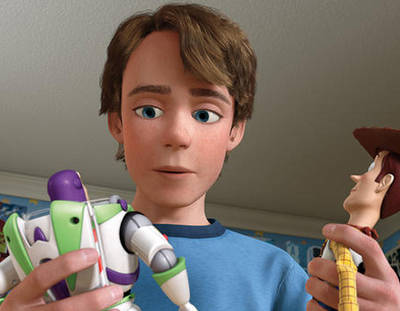
Hannah Brown: A Toy Story Father's Day: Where Is Andy's Dad?

2012-06-16-aumovies_toystory3_1160ucq7.jpg


All kids have favorite movies, but autistic children tend to become obsessed with particular films. My 16-year-old son, Danny, who has autism, has chosen the Toy Story series for his main movie obsession. This is lucky for me and my younger son, because they are amazing. Pixar is the one American movie studio that has consistently produced brilliant work over the last two decades, and the Toy Story series is the jewel in the crown.

While so many movies for children are trite and preachy, the Toy Story films have soared above them all because they are deeply emotional and deal with issues of abandonment and love. Of course, the fact that they are funny and cleverly done helps, but I think it's the underlying emotional pull that draws Danny back again and again (we watch one or two of the films on DVD every Friday afternoon). In the first film, the cowboy Woody doll (voiced by Tom Hanks, his best work, in my opinion) is tossed aside by his owner, Andy, when Andy receives a much jazzier toy for his birthday, space ranger Buzz Lightyear (voiced by Tim Allen). In the sequel, Woody is stolen by an evil toy store owner who wants to sell him, along with a group of other toys who all come from the same vintage Fifties television show, to a Japanese museum for an obscene price. Here, it's Woody who abandons Buzz and Andy's other toys (his family), tempted by the vision of eternal adulation by museum-goers, and fueled by the fear that Andy will soon grow up and leave him behind. In the final installment, Toy Story 3, Andy is deciding what to do with the toys when he heads off to college. They are donated to a day-care center that is run like a prison camp until they return to Andy. On his way to college, he stops off and gives them to another wonderful child.

Danny loves to recite bits of dialogue that are especially meaningful to him. From Toy Story : "No one is getting replaced . . . I'm not worried, you shouldn't be worried." From Toy Story 2: "[Buzz to Woody] You are a toy!/[Woody to Buzz] For how much longer?"

Now, I may be reading too much into all of this, because, as I've made clear, I've seen these films hundreds of times, but I think what lurks behind the abandonment fear that colors the films is the absence of Andy's father. We see Andy's mother and his younger sister, Molly. But where is Andy's dad? He is never seen, or mentioned. In the first film, we see Andy's mom host his birthday party. Well, that's no surprise. Mothers tend to be in charge of birthday celebrations. But she is alone with them throughout, and in the last scene, there is no father present as the family celebrates Christmas.

In the second film, Andy's father is nowhere to be seen when Andy heads off to and returns from camp. And, in the last installment, he isn't there to bid Andy goodbye when Andy leaves for college.

The absence of a father character seems glaring when you look at it like this, but I admit it took me dozens of viewings to even notice it. And it began to intrigue me. So when I interviewed Matthew Luhn, one of the Pixar story supervisors who has been instrumental in all three films, for the Jerusalem Post last year, I asked him about it.

"When you make a movie you have to make sure that every single person is there for a reason. Everyone is there to help tell the main character's story. If there was a dad in Toy Story, the boy would not have had such a need for a doll who represents a kind of authority figure, like Buzz," he said. It was such a simple decision, that "we never even brought it up."

The Toy Story films are among the most popular movies for kids ever -- Toy Story 3 is the eighth highest-grossing film of all time and the three films combined have earned billions of dollars -- and the fact that these films feature a single-parent household headed by a mother has never been an issue. There is no need for even a line of dialogue in any of the three movies to explain the father's absence. This is the new American reality, and it's fine.

But, as Luhn confirmed in our interview, "Woody is driven by a fear of abandonment." And it's the unseen, never mentioned father who is behind this fear. The father is gone, and everyone carries on. But he's left hurt and fear in his wake. The power of these emotions are what make these films classics.

And Danny responds to this: "No one is getting replaced. I'm not worried, you shouldn't be worried."

But we're all worried. So while the dads are being celebrated on their day, you might want to give the single moms in your life new copies of the Toy Story DVDs.

?

Follow Hannah Brown on Twitter: www.twitter.com/HannahBrown972

"; var coords = [-5, -72]; // display fb-bubble FloatingPrompt.embed(this, html, undefined, 'top', {fp_intersects:1, timeout_remove:2000,ignore_arrow: true, width:236, add_xy:coords, class_name: 'clear-overlay'}); });

mega upload santorum wins iowa archer ibooks 2 ifl indoor football league newt gingrich wife

Saturday, June 16, 2012

Zynga And CBS Are Working To Bring Draw Something To Primetime TV

Draw Something ZyngaSo you wondered how Zynga was gonna make money off its $210 million acquisition of OMGPOP? How about this: Hit game title Draw Something will soon be at the center of a new primetime game show, according to a report by Variety. The show's pilot, which was picked up by CBS after an apparent bidding war, will be produced by Sony Pictures Television, Ryan Seacrest Productions, and Embassy Row. According to Variety, the pilot concept will pit multiple celebrities and users against each other in front of a studio audience, translating a title most people play in their spare time while commuting or before bed into a hilarious new game show. Viewers at home will reportedly also be able to play along with the folks on TV. While Ryan Seacrest will help produce, he won't have an on-air role. A host has yet to be picked for the project.

google privacy changes windows 8 preview leap year moratorium dwts season 14 cast leap day michigan primary results

Pentagon to mark gay pride month

WASHINGTON (AP) ? Last summer, gays in the military dared not acknowledge their sexual orientation. This summer, the Pentagon will salute them, marking June as gay pride month just as it has marked other celebrations honoring racial or ethnic groups.

In the latest remarkable sign of change since the military repealed the "don't ask, don't tell" policy, the Defense Department will soon hold its first event to recognize gay and lesbian troops. It comes nine months after repeal of the policy that had prohibited gay troops from serving openly and forced more than 13,500 service members out of the armed forces.

Details are still being worked out, but officials say Defense Secretary Leon Panetta wants to honor the contributions of gay service members.

"Now that we've repealed 'don't ask, don't tell,' he feels it's important to find a way this month to recognize the service and professionalism of gay and lesbian troops," said Navy Capt. John Kirby, a spokesman.

This month's event will follow a long tradition at the Pentagon of recognizing diversity in America's armed forces. Hallway displays and activities, for example, have marked Black History Month and Asian-Pacific American Heritage Month.

Before the repeal, gay troops could serve but couldn't reveal their orientation. If they did, they would be discharged. At the same time, a commanding officer was prohibited from asking a service member whether he or she was gay.

Although some feared repeal of the ban on serving openly would cause problems in the ranks, officials and gay advocacy groups say no big issues have materialized ? aside from what advocacy groups criticize as slow implementation of some changes, such as benefit entitlements to troops in same-sex marriages.

Basic changes have come rapidly since repeal; the biggest is that gay and lesbian soldiers, sailors, airmen and Marines no longer have to hide their sexuality in order to serve. They can put photos on their office desk without fear of being outed, attend social events with their partners and openly join advocacy groups looking out for their interests.

OutServe, a once-clandestine professional association for gay service members, has nearly doubled in size to more than 5,500 members. It held its first national convention of gay service members in Las Vegas last fall, then a conference on family issues this year in Washington.

At West Point, the alumni gay advocacy group Knights Out was able to hold the first installment in March of what is intended to be an annual dinner in recognition of gay and lesbian graduates and Army cadets. Gay students at the U.S. Naval Academy were able to take same-sex dates to the academy's Ring Dance for third-year midshipmen.

Panetta said last month that military leaders had concluded that repeal had not affected morale or readiness. A report to Panetta with assessments from the individual military service branches said that as of May 1 they had seen no ill effects.

"I don't think it's just moving along smoothly, I think it's accelerating faster than we even thought the military would as far as progress goes," said Air Force 1st Lt. Josh Seefried, a finance officer and co-director of OutServe.

He said acceptance has been broad among straight service members and has put a spotlight on unequal treatment that gays continue to receive in some areas. "We are seeing such tremendous progress in how much the military is accepting us, but not only that ? in how much the rank and file is now understanding the inequality that's existing right now," he said.

That's a reference to the fact that same-sex couples aren't afforded spousal health care, assignments to the same location when they transfer to another job, and other benefits. There was no immediate change to eligibility standards for military benefits in September. All service members already were entitled to certain things, such as designating a partner as one's life insurance beneficiary or as designated caregiver in the Wounded Warrior program.

As for other benefits still not approved, the department began a review after repeal with an eye toward possibly extending eligibility, consistent with the federal Defense of Marriage Act and other applicable laws, to the same-sex partners of military personnel.

"The department is carefully and deliberately reviewing the benefits from a policy, fiscal, legal and feasibility perspective," Eileen Lainez, a Pentagon spokeswoman, said Thursday.

Gay marriage has been perhaps the most difficult issue.

Though chaplains on bases in some states are allowed to hold what the Pentagon officials call "private services" ? they don't use the words wedding or marriage ? such unions do not garner marriage benefits because the Defense of Marriage Act says marriage is between a man and a woman.

The "don't ask, don't tell" policy was in force for 18 years, and its repeal was a slow and deliberate process.

President Barack Obama on Dec. 22, 2010, signed legislation repealing it. Framing the issue as a matter of civil rights long denied, Obama said, "We are a nation that welcomes the service of every patriot ... a nation that believes that all men and women are created equal."

The military then did an assessment for several months to certify that the forces were prepared to implement it in a way that would not hurt military readiness. And it held training for its 2.25 million-person force to inform everyone of the coming change and what was expected.

ryan zimmerman oscars red carpet jennifer lopez wardrobe malfunction emma stone hugo hugo nfl combine

Majority of dads say they do the grocery shopping

Brian Snyder / Reuters file

According to a survey, 52 percent of dads say they are the primary supermarket shoppers in the household.

By Eve Tahmincioglu

There?s a good chance dad might be shopping for his own Father?s Day breakfast in bed this Sunday. No, he?s not in the doghouse, but apparently dads are doing more of the grocery shopping these days.

According to a survey released this week by brand marketing firm Cone Communications, 52 percent of dads say they are the primary supermarket shoppers in the household, and 35 percent of moms admitted fathers have more influence when it comes to grocery purchases.?

?This research goes against all stereotypes of the ?Father Knows Best? dad who doesn?t concern himself with domestic responsibilities,? says Bill Fleishman, president of Cone Communications, about the online survey that polled 1,000 parents with children under 17.

The company?s research also found dad shoppers aren?t just winging their supermarket hunting. Dad?s polled said they:

  • Create a detailed shopping list ? 63% (vs. 65% of moms)
  • Collect coupons or read circulars ? 56% (vs. 62% of moms)
  • Plan meals for the week ahead of time ? 52% (vs. 46% of moms)
  • Perform background research on grocery products ? 24% (vs. 11% of moms)

And moms are more likely to spend more time in the grocery store than dads. While Cone?s study found fathers were doing more of the grocery shopping, Today Money Facebook fans we informally polled Friday largely said the opposite it true.

?If my husband went to the store we would be having frozen pizza and macaroni and cheese for dinner every night,? said Mariska Colbert of her husband Zac.

And Melissa Klement added, ?Wish my hubby would do it.?

But Roberta Harwood Speller, who works in a grocery store said: ?There are several men that shop each week there for their families. They do very well. Even have their kids with them.?

For those of us who just can?t accept father foragers in the supermarket, it may be time set aside your bias in the aisle.

?We?re finding that dads are not acting so differently from moms in their approach to grocery shopping,? maintained Cone?s Fleishman.

(Full disclosure: My husband does most of the supermarket shopping these days, but I have to write up the list.)

Who does the supermarket shopping at home?

More from msnbc.com business:

Follow msnbc.com business on Twitter and Facebook

?

?

los angeles angels los angeles angels lindsay lohan̢۪s playboy cover leaked online lindsay lohan̢۪s playboy cover leaked online va tech shooting 2011 coriolanus coriolanus

Friday, June 15, 2012

Lack of Vitamin D to Blame for Black Cancer Deaths? - Healthy You ...

This arti?cle orig?i?nally appeared on?MSNBC

African-Americans are 25 per?cent more likely to die from can?cer than white Amer?i?cans are, and the rea?sons are numer?ous, includ?ing lower socio-economic sta?tus, poorer access to health care, and the can?cer diag?no?sis com?ing at later, more deadly stages.

Still, health experts say these fac?tors can?not fully explain the extent of dis?par?i?ties in sur?vival for?the most com?mon can?cers, such as breast, lung, colon and prostate cancers.

A paper pub?lished in the cur?rent issue of the jour?nal Dermato-Endocrinology points the fin?ger at a seem?ingly obvi?ous but over?looked cul?prit: the?sun.

The researchers? the?ory is that, in north?ern lat?i?tudes, the dark skin of African-Americans can?not absorb enough sun?light to gen?er?ate ade?quate amounts of vit?a?min D, which is often called the ?sun?shine vit?a?min.? The body uses ultra?vi?o?let rays from the sun to man?u?fac?ture vit?a?min D in the inner lay?ers of the?skin.

Vit?a?min D is needed for strong bones; doc?tors nearly 100 years ago asso?ci?ated a lack of ade?quate sun expo?sure with?rick?ets?among child labor?ers, exem?pli?fied by bowed legs. Recent stud?ies also have shown that low lev?els of vit?a?min D in the blood seem to con?tribute to a weak immune sys?tem and a host of dis?eases, such as can?cer and mul?ti?ple scle?ro?sis. [?Info?graphic: The Power of Vit?a?min D?]

This lack of vit?a?min D could com?pletely fill in the health dis?par?ity gap for can?cer sur?vival between white and black Amer?i?cans, the researchers said.

Pre?vi?ous work by geneti?cist Rick Kit?tles at the Uni?ver?sity of Chicago sug?gests that upwards of 75 per?cent of African-Americans are?defi?cient in vit?a?min D. Kit?tles says that African-Americans liv?ing north of the 37th par?al?lel ? just about any?place north of cen?tral Cal?i?for?nia, Texas, Ten?nessee or North Car?olina ? will have dif?fi?culty through most of the year absorb?ing enough sun?light to make vit?a?min D, because of the low angle of the rays reach?ing the Earth?s surface.

Given this largely estab?lished fact, researchers Alan Peiris of East Ten?nessee State Uni?ver?sity and William Grant of the Sun?light, Nutri?tion and Health Research Cen?ter in San Fran?cisco set out to look for a cor?re?la?tion between vit?a?min D and can?cer death dis?par?i?ties. (In past research, Grant and a col?league sug?gested low lev?els of ultraviolet-B rays in Aus?tria, paired with Mozart?s noc?tur?nal habits, may have led to?vit?a?min D defi?ciency in the com?poser, who died at the age of?35.)

What they found in the new study is pre?lim?i?nary but war?rants fur?ther inves?ti?ga?tion, they said. Rely?ing solely on a sci?en?tific lit?er?a?ture review, the researchers found that low vit?a?min D is inde?pen?dently asso?ci?ated with each of the can?cer types for which an unex?plained health dis?par?ity exists between African-Americans and white Americans.

Specif?i?cally, they found lin?ger?ing dis?par?i?ties for 13 types of can?cer after account?ing for socioe?co?nomic sta?tus, stage at diag?no?sis, and treat?ment: blad?der, breast, colon, endome?trial, lung, ovar?ian, pan?cre?atic, prostate, rec?tal, tes?tic?u?lar, and vagi?nal can?cer; Hodgkin?s lym?phoma; and melanoma. For each one, there is a vitamin-D connection.

Read more on?MSNBC

jessica capshaw seattle times seattle times walker recall censor pipa and sopa sopa pipa

Migration from Earth: Human Evolution and Space Colonization

Book Review:
Going Interstellar, edited by Jack McDevitt and Les Johnson.
ISBN-13: 9781451637786
Publisher: Baen Books
Publication date: 5/29/2012

The Man in the Moone

When space shuttle Atlantis rolled to a stop on its runway last year, it did not mark, as some worried, the end of human space flight. Rather, it opened the gates to the continuation of human evolution on the largest scale, the migration of our species away from our home planet.

For half a century, governments controlled access to space with exclusive technologies, but today the technologies have migrated into the public sphere. Half a dozen companies are building spacecraft for private access to space. This is a ?Wright Brothers? period: crazy contraptions will be tried and tested, many will fail, some will fly, and in the end they will be transformed from playthings of the rich to common commuter vehicles. And ultimately, people will want not to just visit space (in such extravagances as Bigelow Aerospace?s inflatable orbital hotels), but to live there; Elon Musk, of PayPal fortune, has publically stated that his long-term goal is to privately fund the colonization of Mars, polar explorers Tom and Tina Sjogren are currently designing a private flight to Mars, and recently, the Europe-based MarsOne project announced its goal of establishing a human colony on Mars in 2023, funded entirely privately, with ?No political mumbo jumbo [and] no taxpayers dollars involved.? The colonization of space is beginning now.

There will always be those who label such ideas as fantasy. In the 1620?s the Englishman Francis Godwin wrote The Man in the Moone, or, a Discourse of a Voyage Thither, prefacing wryly that while it was simply an entertaining fancy, it had once been a fancy that the Earth was spherical. Travel to the moon, Godwin held, was inevitable. I think the same of human space colonization. Throughout human history and prehistory, whenever the material and social conditions for inhabiting a new environment arose, people have taken advantage of them. The geographic range of our species ensures its survival, and the same will be true in the future.

For the past 23 continuous years human beings have already lived off of the surface of the Earth in various orbital stations: Sergei Krikalev has spent over 800 days in space, and Valeri Polyakov once remained continuously in orbit for well over a year. Clearly, the essential technologies for long-term stays in space are well-understood. The peppery space engineer, author and president of the Mars Society, Robert Zubrin, whose 2001 book The Case for Mars: the Plan to Settle the Red Planet and Why We Must has convinced many that Mars (in contrast to the moon) is rich in oxygen and water, is suitable for building farms, and has sufficient resources to manufacture building materials, such as glass and metals, on-site.

Others, notably the late American physicist Gerard O?Neill, developed the idea of giant orbital space colonies, in which?as shown in delightful NASA schematic paintings?people could live in health and plenty, off of Earth, riding bicycles and flying hang-gliders in orbital cities. With engines, such colonies could be turned into Space Arks sent out to the stars. Recently several research groups have begun to design a ?100-Year Starship? to get to grips with the challenges ahead.

But as important as they are, the technological dimensions of space colonization are only a prerequisite; they are necessary to make space colonization work, but not sufficient. No matter how well planned, space colonies?either in great Arks on the way to other stars, or inhabiting bodies such as Mars or asteroids?are not going to survive in the long term if important issues in human biological and cultural evolution are not as carefully considered.

It is time to build a realistic science of the human dimensions of space colonization, one that grapples with the fuzzy, messy, dynamic and often infuriating worlds of genes and people. After all, if it is to succeed in the long run, space colonization cannot be about rockets and robots, it will have to be about living things; bodies, people, families, communities and cultures. And if it is to be about living things, it must be planned with the clearest fact of all regarding living things in mind; that they change through time, by evolution.

Human Evolution, Adaptation and Space Colonization

This new science of human adaptation to off-Earth environments (what I like to call the Extraterrestrial Adaptation) will be heavily influenced by the collective wisdom of anthropology, the scientific study of our species. One of anthropology?s central discoveries has been that humanity has not ascended a ladder of civilization, from ?Savagery? to ?Barbarism? to ?Civilization? in any internally-directed and inevitable way.

Rather, human populations in the past 100,000 years have adapted to a wide array of environments, devising new cultures that match human action to a variety of landscapes. And, we have found that humanity doesn?t rely on biology to adapt. Indeed, cultural behavior (including the use of technology) allows us to live wherever we please despite our relatively frail biology.

Understanding how our species evolves and adapts will be central to shaping intelligent and adaptive space colonization. We cannot assume that humanity is ?destined for the stars?, or that our species will ?conquer space?. We must proactively make space colonization?the extraterrestrial adaptation?happen, and to give it the best chance of success we must understand human adaptation.

The raw material of human biological adaptation is genetic variation. A ?super-race? of clones or genetically very similar people would be a catastrophe in the making because when a single disease or other new variable strikes, all would be subject to the same disaster, with no ?mutants? capable of surviving. For this reason, we will have to ensure that off-Earth colonists are genetically diverse.

Humans have done this for thousands of years, but mainly in large populations that travel freely, mixing genes worldwide. But in the earlier stages of space colonization, populations will be smaller rather than larger, and there will be fewer people with whom to mix genes, such that inbreeding will be a significant danger.

In the same way, cultural adaptation requires flexibility. Cultures must be willing and able to accommodate new conditions by reshaping traditions, religious beliefs, and such technicalities as rules regarding marriage and inheritance. In ancient Polynesia, for example, only a chief?s first son inherited anything, prompting other sons to disperse and explore the ocean for more land where they could built their own fortunes. This was a cultural adaptation that fit human action to the conditions of Oceania.

Clearly, off-Earth cultures will have to maintain the human ?Ace-Up-the-Sleeve? of diversity?genetic and cultural?despite the fact that small, colonial populations can drift towards fundamentalism in an attempt to ?force? a traditional Norse way of life in an alien environment: this is what the Vikings attempted in early Medieval Greenland, and they perished.

Selecting the Colonists: Genetic Lotteries?

Who will be the space colonists? Here we must ditch the old concept of ?crew selection?. Dispersing populations of humans are not ship?s crews with strictly-defined roles, they will have to be normal families and communities for whom space colonization is not a finite goal or end, but a beginning. They will not be on a mission, but living out lifetimes.

Even early off-Earth populations will have to be large?small populations are particularly susceptible to single catastrophes, disease in particular?won?t \be in the billions we have on Earth. The genetic composition of these populations will be critically important because individuals carrying genetic maladies could threaten the future in ways that don?t normally play out in a population of billions. This will apply more to a closed system, such as the ?100-Year Starship? being designed by several teams worldwide.

In this case, no new genetic material could be directly introduced. This might be overcome by carrying stocks of sperm and egg sampled widely from Earth before beginning the voyage, and/or the inducing of mutations at an Earth-comparable rate. In a Mars-colony scenario, people will presumably continue to migrate there from Earth (and back), and this might preserve gene pool diversity. But, as we are about to see, there is no getting around the fact that complex issues of reproductive rights and genetic screening will be a part of human space colonization.

Determining which humans can and cannot participate in off-Earth colonies will be morally complex and a process ripe for misuse and mischief, but we cannot ignore genetics. We should remember that this is nothing new: over thousands of years human cultures worldwide have devised many and elaborate kinship systems and sexual regulations that prevent the genetic disorders associated with close inbreeding.

The main purpose of genetic screening related to space colonization will be the detection of genetic disorders that might send a biological ?time bomb? into future populations. In practical terms, this is evident in a depressing poster generated by the federal Genomic Science Program (https://public.ornl.gov/site/gallery/highres/GenomePoster2009.pdf), a rather gruesome document pointing out the location?on each of our chromosomes?of hundreds of genetically-controlled disorders, from cancers to deafness.

Screening for space suitability here seems simple enough: if you?re carrying certain genes, you remain Earthbound (recently researchers announced that they could screen for over 3,500 such traits in human fetuses, opening whole new domains of moral philosophy). The complication, and it is substantial, is that while some genes are strongly implicated in some genetic disorders?these are called Mendelian traits?more disorders are not so easily ?pinned? onto just one genetic marker. Many disorders are polygenic, the complex result of the interactions of many genes, and single genes can be pleiotropic, affecting multiple characteristics of the individual organism!

And even though one might carry the gene or genes ?for? a certain disorder, environmental factors encountered during the course of life can determine whether or not those genes are activated in such a way as to ?express? the genetic disorder. In short, genetic screening is, and will always be, probabilistic, not deterministic. This particularly applies to the genetics of behavior, where screening, according to Harvard geneticist David Altshuler, is ?especially prone to misinterpretation and misguided policy.?

Considering all this, in the short term a modern screening process would first filter out individuals carrying the best-understood and most debilitating or lethal Mendelian disorders. Next, we would filter out individuals carrying genes known to be most likely affected by the environmental conditions on Mars, or in deep-space colonies, such as different mixes of oxygen and other breathing gases, different gravitational fields and exposures to sunlight and radiation and different food and water supplies than we consume here on Earth.

Despite this screening we must ensure genetic diversity of the gene pool because genetic diversity is a species? health indicator. Early colonial populations,then, should represent human adaptations worldwide (cold, hot, high altitude and so on), to give future populations the best chance of having on hand genes that might be adaptive in these new environments, seen and unforseen.

Finally, we must consider humanity?s Minimum Viable Population, the population needed to maintain a healthy gene pool. This figure has been much debated, but a ballpark of figure in the low hundreds or perhaps 500 is reasonable. I would suggest erring on the side of larger populations, starting with at least four times that. Space colonization should be planned with ever-increasing populations in mind, not with a paradigm of small colonies, which are are at higher risk of extinction. For humans in space, strength will indeed be found in numbers.

First From Earth: The Return of Natural Selection

No matter how ingenious are our technological and cultural adaptations, life off of Earth, at least at first, will be more dangerous and perhaps shorter than on Earth, a planet that we have actively shaped to be as benign as possible for our species. Off of Earth, humanity will again be subject to the natural selection that we have in many ways buffered out of daily life with technology. Not much of this selection will not play out in the dramatic ways we might expect from science fiction movies. Rather, much will occur on the genetic and tissue-development levels.

For example, consider that the most important time in a person?s biological life is arguably during early development of the fetus, when few errors are tolerated. Now consider that the human body evolved under roughly 15 pounds of atmospheric pressure per square inch for several million years, breathing a mix of roughly 80% nitrogen and 20% oxygen. Of course, in free space and on Mars, there is close to a vacuum and since pressure vessels are hard to construct, the lower the pressure they need to hold, the easier and cheaper they will be to build, so atmospheric pressures in a Space Ark or in Mars structures will probably be lower than on Earth. But if you lower atmospheric pressure, you must increase oxygen as a percentage of what you are breathing. Is this solution sustainable over the long term?

Since the 1940?s it has been known that lower atmospheric pressure and elevated oxygen levels interfere in the development of vertebrate embryos. It seems inevitable that in new conditions natural selection will preserve the genes suitable for these new conditions and remove those that are less suitable. For some time, this will play out in increased infant mortality compared to what we are used to today, at least in developed countries, as the off-Earth genome is shaped by its new environment.

Over time, extraterrestrial humans will be shaped by their environment just as Earth humans, including native Andeans or peoples of the Tibetan plateau, who have independently? evolved more efficient oxygen-transport systems in the blood; however, they do sustain higher death rates for infants born at altitude, and actually mothers nearing delivery often descend to oxygen-richer altitudes. We can expect similar natural selection, and attempts to curb it, off of Earth. Women nearing birthing, for example, might ascend from 1/3-g, low-oxygen Mars surface colony to a rotating orbital ?birthing station? that provides a full 1g and richer oxygen breathing mix, to give birth and allow early development to go less impeded.

And we must remember that humans are only one species that will go into space. Thousands of domesticates?plants and animals for food and materials?will accompany us, and they will be subject to new natural selection as well. Finally, so will all of the unseen millions of microbial species that ride on, and in human bodies (see Scientific American ?Your Inner Ecoyssystem?, June 2010) as well as those of our plant and animal domesticates. Many of these invisible ?genetic hitchikers? are critocal to our health, and that of our domesticates, so their genetic health must be undersood and safeguarded as well.

150 Years From Now: New Dialects and Cultures

In either the Mars or Space Ark scenarios, Earth- and non-Earth populations will differentiate over time. There is no stopping this, and rather than resist it, we should accept it as entirely natural and, in fact, a sign of healthy adaptation. If we look ahead 150 years, or five, 30-year generations ?considering all that anthropology knows about humanity? we can expect some significant biological and cultural change.

Human survival to date has been a result of our species? ability to rapidly adapt our cultural practices according to local conditions. In a Space Ark, for example, new concepts of both space and time will change to reflect the reality of living in a closed environment that lacks natural seasons. If cars, for example, are not in general use, what would be the use of the mile or kilometer? People might return to the use of a league, for example, a unit of distance first recorded in Roman documents, of about an hour?s walking.

In time, such new ideas would become the norm. Or on Mars, for instance, people will presumably tire of naming everything with reference to Earth?New New York, New Grand Canyon, New Antarctica. And not just place names, but words for specific phenomena will appear; Martian landscapes include flow features and ice cap topographies that have no convenient or even descriptive equivalents on Earth, and they will be described in new ways.

In the same way, new dialects will arise. In low-pressure, oxygen-rich atmospheres sound will propogate differently?even if subtly?and this could alter pronunciation and perhaps even the pacing of off-Earthers? speech, which will also have liniguistic biases based simply on the language constitution of the founding populations. And it is sure that cultural arrangements related to mating, family structure and inheritance will change over time. Culturally, we should not expect to replicate, for example, suburban Western culture off of Earth; in an environment of resource scarcity (at least at first), that simply will not work. Even religious traditions that bear on the relationship of humanity to the natural world will be subject to adjustment to new understanding of the universe.

Regarding biology, it seems impossible that human reproduction, embryo development and bodily growth will be identical off of Earth as on our home planet. Different gravity conditions and even ambient temperatures and humidity conditions in colonial habitats could all affect human development. In the short term, though it is unlikely that these would lead to speciation, off-Earth humans will begin to look somewhat different than Earth people, and they might well be unsuited to a return to Earth.

300 Years From Now: New Bodies and Languages

Significant genetic change occurs with genetic fixation, when new genes become widespread in a population. How long this takes depends on many factors, but my calculations suggest that a likely time for gene fixation in colonial populations is around 300 to 600 years, or 10-20 generations. If so, in as little as ten generations we should expect significant genetic divergence of terrestrial and extraterrestrial human populations (not to mention those of our domesticate species). In particular, I would expect significant selection against genes that result in poor embryo development in new gravity, pressure, breathing gas and radiation environments, and, concomitantly, selection for (and spread of) genes that allow better health in these conditions.

Within these few centuries I would expect Mars or Space Ark people to look somewhat different from Earth people, with different statures, skin hues, hair and eye colors and, more important than these superficial differences, different genes, different epigenetic issues, and different gene regulation and developmental schedules. People might well evolve new metabolic sytems; on Earth, the ability to digest lactose into adulthood spread rapidly with the domestication of milk-bearing animals around 10,000 years ago, originating simply with mutations that allowed digestion of lactose past the weaning age. It is entirely possible that such new genes will arise and spread off of Earth.

Because of human experience to date, however, I would not expect these distinctions to cause actual speciation; that is, if terrestrial and extraterrestrial people mated after this time, I think on this scale they would likely be able to have healthy offspring. Rather, the differences would be on the level of geographical variations we see in humans today (once referred to as ?races?).

Along with new bodies we can expect new languages. Early exploration of both Asia and the New World resulted in dozens of new words?not to mention ideas?in the languages of Western Europe. Extraterrestrial people will similarly devise new accents, dialects, words and entire vocabularies to describe new phenomena. What metaphors will arise on Mars, where the wind can blow at hundreds of miles per hour ? but because of the reduced atmospheric pressure, its effect is hardly noticeable? When the human experience is so modified by new experiences that new grammars (structures of speech) are required, we will see the evolution of new languages off of Earth. Several centuries is a good ballpark figure for such emergence.

The Distant Future: Speciation and the Evolution of Homo extraterrestrialis

When will we see even more fundamental biological change?speciation?? Speciation is common in nature when sub-populations of a single kind of life become separated or reproductively isolated, adapting to their own conditions to the extent that they may no longer interbreed.

Mammalian speciation can occur as quickly as over a few thousand years (though normally takes much longer). In the case of Homo, we have gone over 150,000 years?migrating into a wide variety of environments, from desert to open ocean?without speciation (the possible exceptions are many thousands of years past, including the cold-adapted Neanderthals, and the apparently miniaturized ?hobbit? humans of the island of Flores in the southwestern Pacific). This is because we normally adapt more culturally than biologically. But as we have seen, we can expect that the return of natural selection and adaptation in Homo will in the long run result in significant biological evolution.

What will Homo extraterrestrialis look like? Will it grow wings, or a hard shell with which to actually survive for a time outside a spacecraft? Will people of Mars grow structures that could split the oxygen from the carbon dioxde in the atmosphere in the way that fish gills separate gaseous oxygen from water? The answer seems to be no, or not for a very long time. This is because such large, structural changes are quite rare in evolution due to a species? genetic heritage, which constrains the innovations that can occur. It seems that humanity will for a long time retain an essentially bipedal primate form. Speciation, then, will more likely have to do with less visible divergence of internal mechanisms, with perhaps a few visible correlates.

On the other hand, if off-Earthers decide to harness the staggering replicative potential of DNA, and control it four their own purposes, it seems likely that in the long run they will design their own bodies for very different environments than on Earth. ?Humans? might well be engineered to have novel metabolic and even locomotor capabilities. Before this, or along with it, humans might also transfer intelligence and even consciousness to non-biological substrates; conscious, exploring systems much more resilient than our current biological form.

Ensuring the Success of Human Space Migration

Human space colonization, as a long-term beginning rather than a short-term goal, is an insurance policy for the human species. It will require plenty of technical advance, but equally important will be to develop an understanding of how human biology and culture adapt to new conditions, and use that knowledge to make space colonization succeed. There is plenty to do, and we may as well begin now, by applying what we know from anthropology to the breathtaking goal of ensuring human survival by migrating from Earth.

mark martin cleveland news daytona race the cutting edge fox 8 news indy 500 angelina jolie leg

Recession, Stalemate in Washington vs. Obama's record

This transcript is automatically generated

Long term remember that the economic vision of mr.

Romney and his allies in congress.

What's tested just a few years ago we try this.

Their policies did not grow the economy.

Cannot grow the middle class.

They did not reduce our debt.

Why would we think that they would work.

Better this time.

He has put together almost as much public debt as all the prior presidents combined.

You want four more years of that.

You call that forward.

That's forward over a cliff.

That that's forward on the way to Greece I don't want that I will finally get America on track to have a balanced budget that we will limit the size of government.

Obama and got a.

Romney almost bumped into each other today President Obama and governor -- both in Ohio and both playing out there competing economic visions.

Farm presidential candidate senator Fred Thompson -- there thank you good with you put it takes a lot harder -- a bad economy to be the incumbent he said his statement president Obama's that we test that we tried this he's been an -- three and a half years the first thing I thought of the Yangtze at 69000 jobs in May which was terrible which is -- and out of -- up eight point 2% so under that theory we tried -- he's argued against himself.

Yeah yeah he's between a rock and a hard place.

-- for the last.

Three and a few years he's been demonstrating the -- and understand the basics of the economy and what to do about.

They came in very convinced that games' in economics you bail amount.

They were very brash about what they thought the unemployment.

Percentage would be after -- policies were a student dead wrong about that dead wrong about the effect of the stimulus.

Went around -- that you know we don't turn this thing around me you know give us you know you can kick us out Clinton said that.

And couple years ago.

As well as Obama so now.

They can only resort he can only resort to going back and the reason he stumbled so much -- because he's looking backwards all the and that's a strategy apparently.

Well it certainly -- width and blessing economy starts soaring between now and November if it continues to stay as it is or even declines -- all those problems in Europe which could have a ripple effect.

Which we're likely to feel here at home.

Is that it almost becomes what we're governor -- doesn't even need an economic strategy or policy because I would think that the voters think -- but he.

But because we've we've tried this and didn't work so unless unless he shows you are an improvement and strong trend.

Governor Romney.

Is -- and tactically doesn't mean I would say that the shop much.

I think that's a big dangers when would get a -- I think that I.

I'm not suggesting you do that -- and that it let's admit.

That is due to the event and on the day you know the president didn't seem to feel this way right now it's gonna be the person that the people feel like.

Is gonna do the most for the economy in the future and the one that will be the best caretaker going forward -- There's sort of looking back here and I think that LeBron is getting his legs under him they made a very good speech -- they didn't use approach teleprompter.

President was up there you know same old teleprompter saying little -- been giving you know same old litany of good things that presence of them saying they wanted since George Washington.

I -- which is -- you're working against.

So.

I think that.

You know the president is.

Is intent on rewriting history.

He talks about the failed policies of the past you know Republicans don't wanna be tied to George W.

Bush anybody else so they let that person shouldn't.

People are to me anyway I don't have to let that parents should leave.

The policies of George WW bush should not be measured but the last 24 hours -- worst year of his administration.

Fact my bush tax -- she didn't cause this -- didn't cause this deficit after the bush tax cuts we have the greatest increase in revenue for the federal government.

In the history.

And lots of things -- recessions you know we've had five or six of them in my generation.

We always come out of recession.

I've actually congress we've can be blamed that collectively for the analog reception because of the housing bubble and and their inability to be good stewards of our economy and all the things with Fannie Mae and Freddie Mac so there's a week so -- Moos there -- and a lot of there's a lot of blame to go around you know what I -- us it said the president strength was in inspiring people.

And today he see says something he admits economically that and that our economy isn't where it needs to be.

And I thought you know he's he's he's he's so off -- balance in terms of inspiring people obscenity you know I -- He's used -- making admissions that I think take away from it strikes.

He's literally out of things to say.

I mean they -- this is there's a framework speech you know going forward and all but you know the president at this -- the game with this economy.

I was standing up there I'm saying -- our plan is education.

Infrastructure.

Balanced budget balanced budget -- it but but all those I mean.

Come home I mean you know we have now.

A half a million more people unemployed.

Then.

Than we did the day took office.

He can't escape his own.

Tenure in office you know weren't -- Romney did twenty years ago -- the private sector he thinks is Roland what bush did you know 458.

Years ago we've -- drove it.

But what he's doing today him for the last three and a half years.

Is not relevant the fact of the matter is.

That and we got out of this recession about a half a year and and Obama's first years.

I mean if you talk about.

Turning turning the corner about six months then we turned the corner built up to grow through about 4% of their time in the last part of his first year.

-- the first part of his second year we were up to about 4%.

Then there's something strange happened usually who have moved the -- the recession the quicker the bounce back we started bounced back and then something happened.

And that was that things turned back around again just -- his spending.

Started kicking and the economy started going down has been going down ever sense and now it's more what one point 71 point eight.

Is that growth -- and he says he's got six months so our last 200 that are up there on time.

There's no -- bed and you know you know singling out the 1% you noted demagogue.

There's there's not gonna get it done he's talking about dividing the country and then re dividing the economic times simply trying to make the -- bigger -- about it.

chapter 11 bankruptcy big ten acc challenge 2011 john wayne gacy amr jack del rio fired jack del rio fired made in america

Police: Sapulpa Coach Admits To Placing Cameras In Girls' Locker Room

',
calendar:'',
week:'{week}', dayClickable:'{date}', dayCurrent:'{date}', dayNone:'', day:'{date}', search:'' }, // Stored objects $container = $(loc), now = new Date(), current = now, minDate = new Date('12/5/2007'), station = wng_pageInfo.affiliateName||'kotv', months = ['January', 'February', 'March', 'April', 'May', 'June', 'July', 'August', 'September', 'October', 'November', 'December'], monthLengths = [31, 28, 31, 30, 31, 30, 31, 31, 30, 31, 30, 31], // Helper methods renderTemplate = function(tpl, vars) { var retVal = templates[tpl]; if (typeof(retVal) === 'string') { for (var i in vars) { var regEx = new RegExp('\{' + i + '\}', 'g'); retVal = retVal.replace(regEx, vars[i]); } } else { retVal = null; } return retVal; }, // Renderers makeCalendar = function(date) { // Copy the date to a new object (so as not to overwrite the original) and set us to the beginning of the month date = new Date(date); date.setDate(1); current = date; var month = date.getMonth(), year = date.getFullYear(), firstDay = date.getDay(), out = '', days = '', colCount = 0, monthLength = monthLengths[month] + (month == 1 && year % 4 == 0 ? 2 : 1); // Figure up the month length taking into consideration leap years. Not accurate to 100+ years // Render the days before the start of the month if necessary for (var i = 0; i = minDate) { tpl = 'dayClickable'; } days += renderTemplate(tpl, {date:i}); colCount++; if (colCount % 7 == 0) { out += renderTemplate('week', {week:days}); days = ''; } } // Tack on the last week if (days != '') { out += renderTemplate('week', {week:days}); } // Render to the DOM out = renderTemplate('calendar', {days:out}); out = renderTemplate('controls', {month:months[month], year:year}) + out + templates.search; $container.html(out); // Determine whether the previous/next buttons should be shown date.setDate(1); if (date 12) { month = 1; year++; } makeCalendar(new Date(month + '/1/' + year)); } }, // Init init = function() { $container.addClass('gnmCalendar'); makeCalendar(now); }; init(); };

hcm loretta lynn gene kelly zoe saldana zooey deschanel and joseph gordon levitt debra messing ayaan hirsi ali